

T: +86-20-86973099
E: sales@xqglasses.com
E: sales@xqglasses.com
NO.3, Yongfu Road, Sandong Avenue West, Huadu District, Guangzhou City, Guangdong Province, China
Views: 0 Author: Site Editor Publish Time: 2026-06-01 Origin: Site


Off-road riding pushes enthusiasts into unique environmental extremes on every single trail. Low-speed physical exertion combined with heavy perspiration creates severe physiological and vision challenges. Flying debris, sudden branches, and unpredictable terrain constantly test rider reaction times. You cannot afford to lose visibility for even a fraction of a second.
Standard eye protection like casual sunglasses or basic street helmet visors easily fail under these harsh off-road conditions. They often trap body heat, causing instant fogging, or allow fine silt to intrude during dusty rides. Worse, standard lenses can suffer catastrophic failure upon heavy impact from flying rocks. Riders lose critical visibility exactly when they need it most.
This guide moves beyond basic safety advice to evaluate why purpose-built eye wear remains essential for track and trail survival. We will explore how these specific designs systematically outperform street alternatives through advanced ventilation and impact deflection. You will also discover clear strategies for assessing and choosing the perfect pair for your specific riding conditions.
Complete Seal: Multi-density foam creates a barrier against dust and sweat that safety glasses cannot match.
Impact Deflection: Polycarbonate lenses are engineered specifically to withstand high-velocity "roost" (rocks/mud) from other riders.
Vision Maintenance: Integrated ventilation and tear-off/roll-off compatibility prevent fogging and mud buildup better than standard helmet visors.
Helmet Integration: Modern goggles are designed to lock into the "eye port" of an off-road helmet, utilizing silicone-backed straps for zero slippage.
Many new riders assume street motorcycle helmets work fine for off-road trails. They quickly discover a harsh reality. Street visors create a dangerous "greenhouse effect" during trail rides. Off-road riding demands high physical exertion at much lower speeds than highway riding. You generate massive amounts of body heat and sweat. A closed visor traps this heat and moisture instantly. It blocks ambient airflow and causes the shield to fog up completely. You lose your sightlines in seconds.
Visors also act as massive dust traps. When you follow another rider, fine dust swirls up from under your helmet's chin bar. The enclosed space acts like a vacuum. It pulls the airborne dirt directly into the helmet cavity. The dust then gets trapped squarely in front of your eyes. This leads to severe irritation and forced stops.
Standard safety glasses offer a similarly flawed alternative. They severely lack a functional facial seal. Without this critical barrier, crosswinds easily blow micro-dust into your eyes. Furthermore, safety glasses feature no dedicated retention system. High-vibration terrain causes them to bounce violently on your nose. A minor branch impact can dislodge them entirely, leaving your eyes exposed.
Proper off road eye protection requires a distinct approach. It demands a micro-climate seal pressed directly against your face. This strategic barrier entirely bypasses the internal airflow issues of a standard helmet. It keeps heat away from the lens while completely blocking external dust.
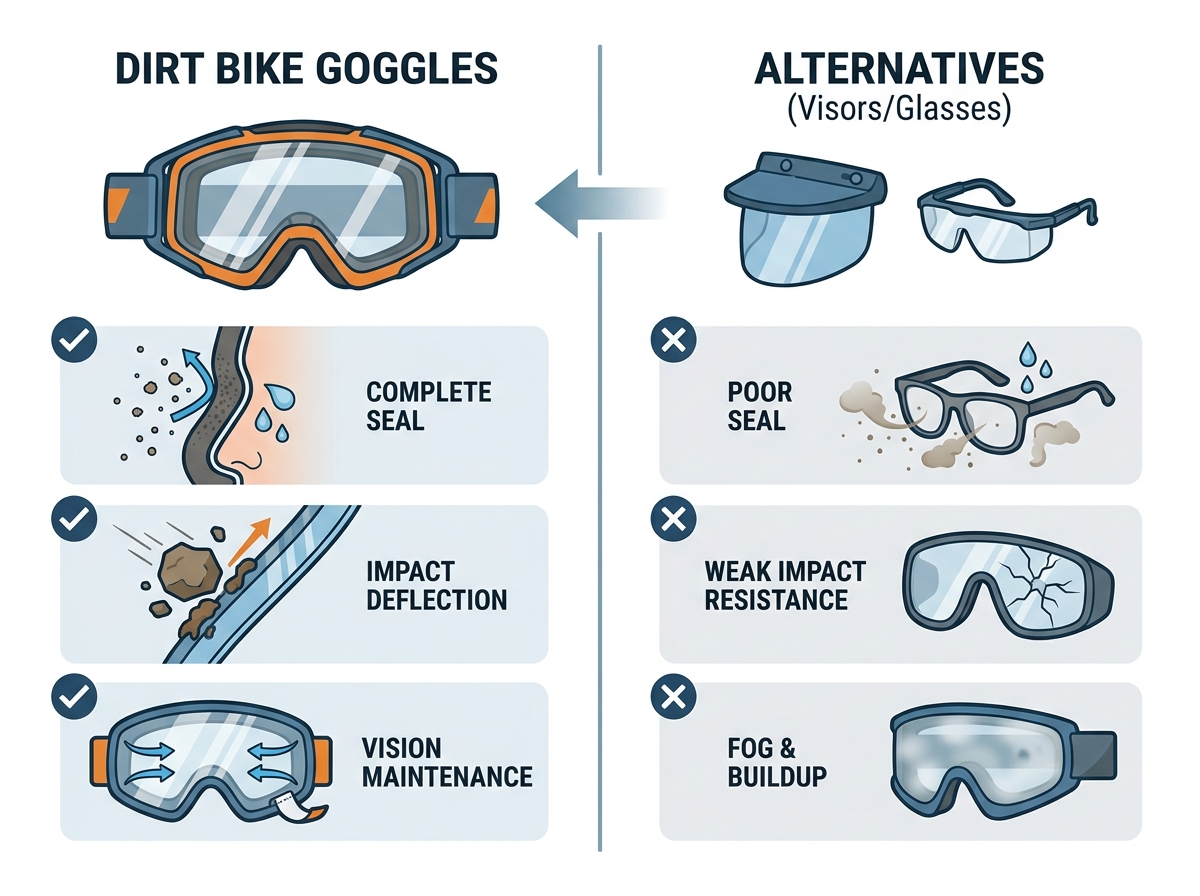
Trail riding and motocross subject riders to intense projectiles. We call this flying debris "roost." When a 450cc dirt bike spins its rear tire in front of you, it launches rocks and hardened mud backward at high velocity. Standard plastics shatter under this intense force. Purpose-built models utilize impact-rated polycarbonate lenses to absorb these kinetic strikes. They act as armor for your eyes. They also deflect low-hanging branches in tight woods, preventing devastating eye injuries. Many top-tier lenses carry specific ANSI impact ratings, proving their structural integrity under extreme stress.
Riding in dry, arid environments exposes you to talcum-like silt. True dust proof dirt bike goggles rely on highly engineered, multi-density foam systems. Manufacturers typically stack two to three distinct layers of foam between the frame and your face.
This foam serves two crucial functions simultaneously. First, the outer, denser layers act as a micro-filter. They block fine silt and sand from penetrating the main chamber. Second, the soft, inner fleece layer sits against your skin to wick sweat away. It pulls moisture from your forehead before it can drip into your eyes. This dual-action performance prevents painful dust irritation and stinging sweat.
Spatial awareness dictates your safety on unpredictable terrain. Bulky safety glasses often feature thick plastic arms. These arms heavily restrict your peripheral vision. Modern Dirt Bike Goggles feature aggressive, wide-frame architectures. They push the outer edges of the frame closer to the helmet shell. This design vastly increases your field of view (FOV). A wider FOV proves crucial for spotting hidden ruts out of the corner of your eye. It allows you to track surrounding riders accurately and react to sudden trail hazards instantly.
Selecting the right setup involves more than picking a frame color. You must carefully evaluate the vision management systems designed to keep your sightlines clear in adverse weather.
We must clarify a hard truth. No lens is absolutely 100% fog-proof under every possible extreme condition. However, premium models combine multiple technologies to dramatically mitigate moisture. They apply hydrophilic chemical coatings to the inner lens surface to disperse water vapor. Furthermore, they incorporate active frame ventilation. These "ram-air" intakes scoop fresh air through the top foam and pull moist air out the sides. This constant circulation keeps your vision clear during intense exertion.
Mud buildup destroys visibility faster than anything else. Riders utilize two primary systems to clear lenses on the fly.
Tear-Off Systems: These utilize stackable, ultra-thin clear films mounted over the main lens. When mud splatters your vision, you simply pull a small tab to rip off the dirty layer. A fresh, clean view instantly appears. They work best for motocross tracks and dry, lightly muddy conditions.
Roll-Off Systems: These mount two small film canisters on either side of the lens. You pull a cord to advance a continuous strip of clear film across your field of view. They excel in extreme mud or deep woods enduro riding. They never leave plastic litter on the trail and provide continuous clearing when tear-offs would run out.
Lens tint significantly impacts contrast and depth perception. Visible Light Transmission (VLT) measures how much ambient light passes through the lens to your eye. Lower numbers mean darker lenses.
Lens Tint | Estimated VLT | Ideal Riding Conditions | Contrast Effect |
|---|---|---|---|
Clear | 85% - 90% | Deep woods, night riding, heavy overcast | Neutral. Shows true colors and maximum light. |
Amber / Rose | 40% - 55% | Flat light, dawn/dusk, shifting shadows | High contrast. Helps define ruts and edges. |
Smoke / Dark Grey | 20% - 30% | Bright, direct sunlight, open desert | Reduces severe glare and eye fatigue. |
Mirrored (Iridium) | 15% - 25% | Intense sun, sand dunes, snow tracks | Maximum glare reflection. Darkens view significantly. |
Even the most expensive eyewear fails if it interacts poorly with your helmet. Proper implementation requires checking several physical constraints before you ride.
Every off-road helmet features a specific opening called the eye port. Buying oversized frames carries a distinct risk. If you force a massive frame into a smaller helmet eye port, the helmet shell pushes the frame downward. This severe downward pressure pinches your nose shut. It severely restricts your nasal breathing during heavy exertion. You must ensure the frame sits cleanly inside the helmet cutout without contacting the top or bottom edges.
Rough terrain subjects your head to constant, violent vibration. Standard elastic straps eventually stretch and slip. Off-road specific straps feature thick waves of silicone beads along their inner surface. These beads aggressively grip the smooth plastic shell of your helmet. They prevent the strap from vibrating downward or snapping upward over the helmet ridges. Proper strap placement ensures the foam seal stays locked against your face.
Riders who require prescription glasses face unique challenges. Standard frames will violently crush your prescription eyewear into your temples. You must look for Over-The-Glasses (OTG) models. OTG designs feature specific structural differences. They utilize deeper frame profiles to provide clearance for your everyday lenses. They also feature dedicated cutouts in the side foam. These cutouts allow the arms of your prescription glasses to pass through without any painful pressure points.
Understanding the market hierarchy helps you make a confident purchase. The price gap between basic and premium models generally stems from material quality rather than branding alone.
Foam Construction: Entry-level models often use single-layer foam. It breaks down quickly and irritates the skin. Premium models utilize triple-layer foam for superior sweat wicking and longevity.
Lens Technology: Basic models use flat, die-cut Lexan lenses that bend into shape, causing slight visual distortion. Premium variants use pre-curved, injection-molded polycarbonate for absolute optical clarity.
Frame Architecture: High-end models feature outrigger strap systems. These external arms pull the strap forward, allowing the frame to seat more evenly against your face inside deep helmets.
When finalizing your decision, prioritize foam quality and helmet fitment over flashy aesthetics. A scratched, cheap lens can be replaced easily for a few dollars. However, cheap, scratchy foam ruins a ride immediately by causing severe skin chafing. A poor fit that pinches your nose restricts your breathing and decreases your overall endurance.
Never buy eyewear blindly. You should test them directly with your specific riding helmet. Put your helmet on, insert the frame, and adjust the strap. Check for painful pressure on your nose. Look left and right to verify your peripheral vision. Ensure the multi-density foam seals completely around your cheeks and forehead without any air gaps.
The primary benefits of dirt bike goggles extend far beyond simple style. They provide a vital, micro-climate barrier against intense roost, blinding dust, and stinging sweat. By utilizing impact-resistant lenses and advanced multi-density foam, they keep your vision perfectly clear under the harshest physical extremes. This pristine visibility ultimately translates to extended ride times, significantly reduced eye fatigue, and vital trail safety.
Take a moment to evaluate your current off-road helmet setup today. Assess your primary riding environment to determine if you need dual-pane lenses for cold weather, or a robust roll-off system for deep mud. Browse a curated selection of purpose-built eyewear, match the lens tint to your local terrain, and secure the precise fit you need for your next ride.
A: No. Polarized sunglasses pose severe safety risks off-road. They lack proper impact ratings to stop high-velocity rocks. They provide zero dust seal, allowing dirt to freely enter your eyes. High-vibration terrain easily bounces them off your face, leaving you entirely unprotected when you need visibility the most.
A: Keep moving forward to allow the ram-air intakes to circulate fresh air through the frame. Ensure your inner foam stays relatively dry before riding. For extreme cold or wet weather, upgrade to a specialized dual-pane lens. This creates a thermal barrier that stops condensation entirely.
A: OTG stands for Over-The-Glasses. These frames are engineered specifically for riders who wear prescription glasses. They feature a deeper internal volume to clear everyday lenses. They also include specific foam cutouts on the sides to prevent the frame from crushing your glasses into your temples.


